Asking a child to solve 47 + 38 would generally result in their immediate use of a calculator or finger counting. Asking an abacus expert would likely lead you to getting an answer even before completing your question. An abacus is a simple tool consisting of bead strings and has been around for thousands of years. It has been found to be one of the most popular tools for developing skills in mental mathematics. In this guide, you will get to know all about it, its history, mechanism, advantages, and how to choose the right course for yourself.
What is Abacus?
The abacus is an ancient calculating device consisting of a frame, a number of parallel vertical rods, and sliding beads on the rods. The dividing horizontal bar is known as the beam (also reckoning bar). Depending on the position of the beads on the beam, numbers can be represented; shifting them according to certain rules, one can perform arithmetic operations (including operations with decimals and square roots).
The abacus is not a computer. There is no memory in the abacus; there are no electronic devices either. It is the man who thinks; beads only illustrate his thinking.
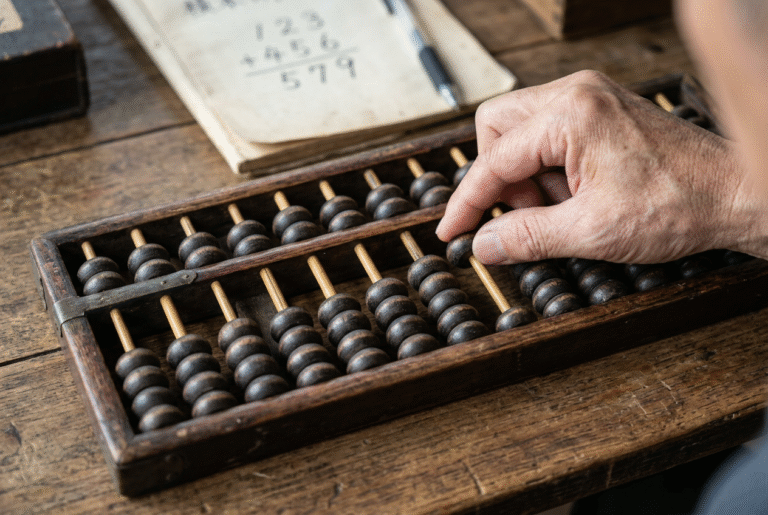
The History of the Abacus in a Few Lines
Mesopotamia, 2500 BCE: Some of the first counting devices discovered used by Mesopotamians are considered to be forerunners of the abacus.
Ancient Greece and Rome: Counting boards and bead frames were used by business people to calculate and pay taxes.
China (suanpan): The history of the abacus in China is traced back to at least the 2nd century CE, when it was the primary calculating instrument for Chinese business for many centuries.
Japan (soroban): The abacus entered Japan around the 14th to 16th centuries. Japan developed the abacus into the sleeker and speedier soroban, which is the type most abacus courses taught to children employ today.
A well-known story from 1946 illustrates just how powerful the device is. In a competition held in Tokyo, the soroban expert won most rounds against the operator of an electric calculator. Modern computers have become much more advanced than before, but this story proves that the human brain is capable of computing quickly enough.
The Parts of an Abacus
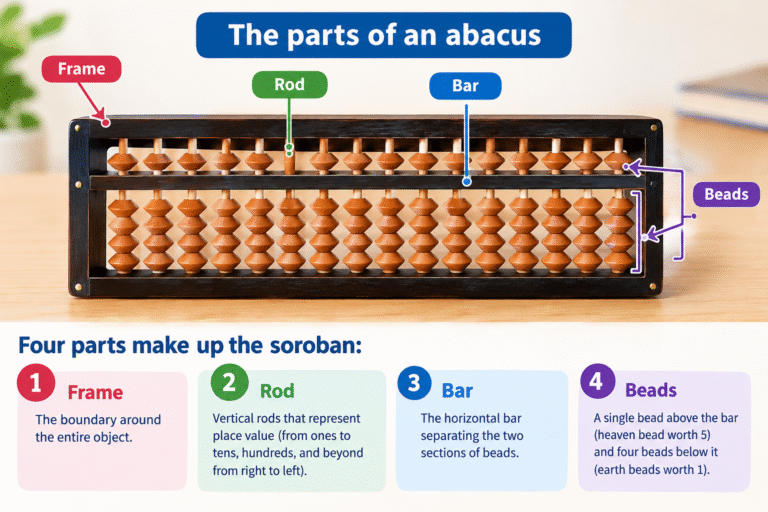
Four parts make up the soroban:
- Frame – the boundary around the entire object.
- Rod – vertical rods that represent place value (from ones to tens, hundreds, and beyond from right to left).
- Bar – the horizontal bar separating the two sections of beads.
- Beads – a single bead above the bar (heaven bead worth 5) and four beads below it (earth beads worth 1).
How to Read Numbers on an Abacus
Only those beads that are moved towards the beam make a count; beads that are moved away from the beam are not counted.
- Three earth beads have to be moved up to the beam to display 3 on a rod.
- Moving the heaven bead down to the beam will give 5.
- For displaying 7, we move the heaven bead (5) plus two earth beads (2).
- The highest number that can be used in the rod is 9 because it is made up of the heaven rod which is 5, and the earth rods, which make 4.
In case one needs to express 356, he/she will put 3 in the hundreds rod, 5 in the tens rod, and 6 in the ones rod. This procedure will always remain the same regardless of the rod.
How Abacus Learning Works: From Beads to the Mind
Learning on an abacus takes place in three stages:
- Physical abacus: Here, the child learns to place numbers and manipulate beads appropriately using his/her fingers in a process that improves speed and coordination.
- Visualization: Here, the child can either close his eyes or look at something blank and imagine the abacus manipulating imaginary beads using his/her fingers as he/she solves the problem.
- Mental calculation: At this point, the child does not need any finger movement since the “mental abacus” will be working within him.
During this process, children learn formula combinations and simple addition/subtraction rules when there is no bead left on a rod. Repeating such formulas makes speed possible.
What Abacus Learning Develops in Children
Learning abacus involves using your eyes, your hands, your ears, and your mind all together. Some benefits noted by parents and teachers include:
Fast mental calculations: Sums happen quickly and effortlessly.
Concentration: One misplaced bead will spoil the sum, hence the need to concentrate.
Visualization and working memory: Creating an imaginary abacus in mind works your visual spatial memory.
Good listening skills: Most of the abacus classes have sums that are done when reading out numbers.
Self-confidence: Children who are good with numbers tend to be confident.
Development of fine motor skills: Working with beads with your fingers enhances your coordination, mostly in young children.
Please keep in mind that there is a lot of positive research on abacus but it does not provide a definite result for everyone, and the results are individual. There is much evidence of the effectiveness of the mental abacus in developing fast calculation skills and visual-spatial memory. The transfer of the gains to other areas will depend on the child and mostly on regular training. Abacus should be seen as a useful tool and a brain trainer, not as a magic wand.
Abacus Vs Calculator: Is It Still Important?
Calculators provide us with solutions, whereas an abacus helps us understand things. People using an abacus gain a good understanding of place value and numbers. This is also helpful in arithmetic that is taught in schools. In addition to this, abacus also develops a habit of mental estimation and verification of solutions, which proves helpful in examinations as well as in practical life.
What Age Is Right to Start?
All programs begin around the age of 4 years. At this age, children learn how to recognize numbers and how to count using an abacus. Early commencement is quite common; however, school children or even adults may be taught abacus. No previous mathematical knowledge is necessary.
What a Good Abacus Course Should Include
Here is what to look out for before enrolling your kid into such an online course:
- Structuring of the Levels: Each successive level should have more difficult topics such as addition, subtraction, multiplication, division, decimals, and negative numbers.
- Good teachers: Children at a young age require fun and engaging lessons.
- Interaction with a live teacher: The teacher should be able to monitor your kid’s technique and correct any errors.
- Practice and testing: Your kid will only learn through practice and feedback.
- Certification: Each level and time taken should be known.
- Demo class: Every decent provider will offer you one.
Learn Abacus Online with Delighted Champs
Delighted Champs provides live online abacus classes for kids from age 4 and above on the basis of a 9-level certification process. This program follows the exact same path as described above:
- Toddler Level: number recognition (1 to 50 and 1 to 100) and basic additions and subtractions.
- Initial Levels: additions, subtractions, and 8 and then 16 combinations formula.
- Middle Levels: 3- and 4-digit additions/subtractions, multiplications, and division.
- Advanced and Grand Levels: high-digit calculations, division using two-digit divisors, decimal points, and negative numbers.
How do the classes work:
- Duration of each class = 1 hour; Classes per week = 2 and Classes per level = 24+.
- Live tutoring services offered 7 days a week with flexible timings across all time zones.
- The classes are done online through a browser; no downloads are required.
- Adults can enroll for a separate class for better mental math abilities.
- Free classes for NGO-backed and underprivileged kids.
FAQs
Abacus, is it just for kids?
Not necessarily. Although it is children who gain the maximum advantage due to their highly malleable brains, adults too may train with an abacus for enhancing mental calculation skills and number confidence.
Do I need my child to have a knack for maths?
No. The courses take children through the fundamentals, and in fact many kids who had difficulty with basic maths initially get along fine with abacus.
When will I see results?
In a few months of training, the children usually show significant improvement in speed and concentration.
Is there any difference between online and classroom abacus courses?
Online courses can also prove to be as useful as classroom courses, but on one condition—the courses should be interactive so that the teacher can assess finger movements and provide feedback while the child trains regularly at home.
How much time do we need to devote to abacus?
Short but frequent practice is more effective than occasional lengthy practice.
Start Your Child's Abacus Journey
The abacus is so enduring through the ages because it makes sense; it transforms numbers into concrete experiences that kids can see, touch, and eventually visualize in their minds. If you want to experience what this is all about, schedule a demo.
👉 Explore the Abacus course and book a demo
📞 Call: +91 7987764868