
You have accessed the online abacus tool, and you find that there are 13 rows of beads available in it. What do you do now?
Don’t get scared, because although the abacus tool might seem complicated to use at first, it is actually governed by a few basic principles only. All that you will need in order to go from using your first bead to solving the first multi-digit arithmetical sum is found in these pictures.
How to read the pictures: beads moved towards the center are counted (colorful); beads left by the sides aren’t counted (dim). White border outlines moved beads.
Step 1: Open the Tool and Know the Button
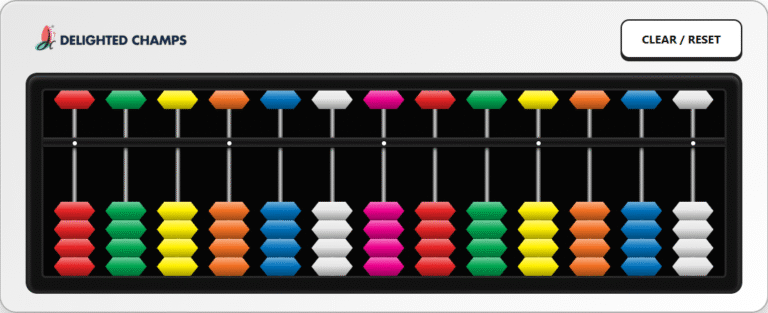
Open the Delighted Champs online abacus tool in any browser on your phone, tablet, or computer. You’ll see a dark frame with 13 rods, each in a different color. Across the middle runs the reckoning bar, also called the center bar.
You need to push just one button, the Clear / Reset button that is placed at the top right-hand side, in order to restore all beads back to their original position. Always click this button before each new calculation in order not to interfere with the beads left from the previous calculation.
Golden rule: a bead only counts when it’s moved toward the center bar. Beads left at the top or bottom edge are worth nothing.
Step 2: Get to Know the Rods and Beads
All the rods have the same amount of beads. Each rod will have one bead above the crossbar and four beads below the crossbar. In contrast to the ones rod, one bead above the crossbar represents five, while one bead below the crossbar represents one.
The right rod is the ones rod. Each rod is worth ten times more when moving to the left than the previous rod, such as ones, tens, hundreds, thousands, and many others. The small white dots in the center rod function as commas in a large number, marking every third rod.
[Image 1: anatomy of the abacus, showing 73,051 with the upper bead, reckoning bar, lower beads, and place values labelled]
Step 3: Set the Numbers 0 to 9
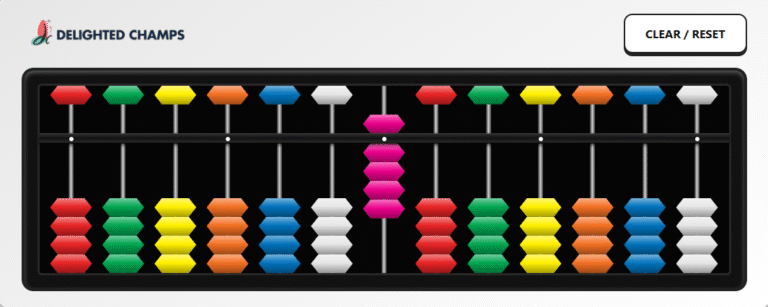
Each rod can show any digit from 0 to 9.
It is very easy to remember. Zero means that no beads are used. Numbers from 1 to 4 are represented using lower beads, while number 5 is represented using only one upper bead. Numbers from 6 to 9 are represented using an upper bead plus one to four lower beads.
You can test this by yourself. Just click Clear/Reset and enter 3, 5, 8, and 0 in the ones place.
Step 4: Set Bigger Numbers.
To set a multi-digit number, set one digit per rod, starting from the left digit and working right. Here is 4,306.
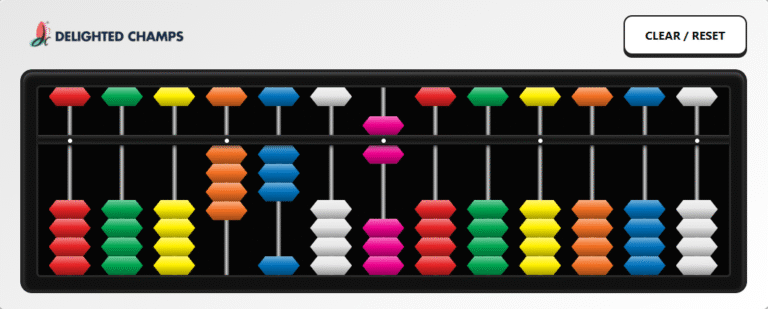
Why does it work?
Since 8 = 10 – 2. Besides 8, you will need 1 bead on tens rod (10) and -2 beads on ones rod (-2). In subtraction of 8, it will be the other way round, in which you will require -1 bead on tens rod (-10) and +2 beads on ones rod (+2).
All the formulas in one place
Number | To add, think | To subtract, think |
1 | +5 − 4 | −5 + 4 |
2 | +5 − 3 | −5 + 3 |
3 | +5 − 2 | −5 + 2 |
4 | +5 − 1 | −5 + 1 |
5 | +10 − 5 | −10 + 5 |
6 | +10 − 4 | −10 + 4 |
7 | +10 − 3 | −10 + 3 |
8 | +10 − 2 | −10 + 2 |
9 | +10 − 1 | −10 + 1 |
You only use a formula when the rod doesn’t have the beads to do the move directly. For 1 to 4 use the ±5 version, and for 6 to 9 use the ±10 version, which moves a bead on the next rod. These pairs are the “formulas of combination” taught in our Movers levels, and repeated practice turns them into habits.
Step 8: Practice With Sample Sums
Do one set at a time, and press Clear / Reset before each sum.
Set | Focus | Sums | Answers |
A | Warm-up, no tricks | 3 + 2, 4 + 5, 12 + 13, 30 + 24 | 5, 9, 25, 54 |
B | Upper bead | 3 + 4, 24 + 13, 7 − 4, 36 − 14 | 7,37,3,22 |
C | Crossing tens | 7 + 8, 9 + 6, 26 + 38, 15 − 8, 42 − 17, 63 − 28 | 15,15,64,7,25,35 |
D | Challenge | 48+37,123+289,500−178,3,405 +2,687 | 85,412,322,6092 |
If you got the incorrect answer, reset the first number. The problem will most likely be a mispositioned bead, and the answer will most likely be correct.
Common Mistakes and How to Fix Them
- Counting beads far from the bar. Only beads touching the center bar count.
- Adding to the wrong rod. Say “ones, tens, hundreds” aloud and use the dots on the bar as anchors.
- Forgetting to carry. Think: Is the answer 10 or more? If yes, move a bead on the next rod.
- Starting from the right. On the abacus, work from left to right, unlike paper maths.
- Skipping Clear / Reset. Leftover beads from the last sum spoil the next one, so make a reset for your first move.
- Practicing too long. Tiredness leads to careless errors. Stop after 10 to 15 minutes and come back tomorrow.
A 7-day practice plan
This plan is a suggestion for beginners, so adjust it to your child’s pace.
Day 1: Learn the reset button, rods, and bead values.
Day 2: Digit exercises from 0 to 9, aiming for less than 3 seconds for each digit.
Day 3: Work on 2 and 3 digits and aim for 10 consecutive correct answers.
Day 4: Work on addition and subtraction and complete Set A independently.
Day 5: Upper bead formulas. Finish Set B.
Day 6: Crossing the tens. Finish half of Set C.
Day 7: Review and celebrate. Finish Set C, then try one sum from Set D.
Tips for parents and teachers
Keep it fun. Brief and light sessions work better than lengthy ones.
Follow your child’s lead. Ask your child to teach each step to you, because teaching is the best form of learning.
Speak it out. Recite the numbers slowly in sums to build listening abilities along with calculation.
Work hard and not fast. Accuracy is always important than speed.
Close your eyes. Once your child feels comfortable doing a sum on an abacus, make them imagine the abacus in their mind and manipulate the beads there.
When to Switch to Live Classes
This software is really useful for practice, but only an expert teacher will be able to notice any bad habits that a beginner does not know about, such as incorrect body movements or a wrong understanding of some formula. It’s time to consider trying live lessons if your child successfully completed Sets A to C and wants to learn more.
There are live online classes in abacus for children from age 4 up, including 9 levels of certification courses. Classes are held two times a week for one hour with at least 24 classes per level.
FAQs
What is the time required to master the basic things?
Most new learners are able to set digits and do basic calculations within a week after practicing for a few minutes each day.
Which rod is the ones rod?
The rightmost rod you’re using. Each rod to its left is worth ten times more.
Do I need to memorize the formulas?
Yes, but gradually. Repeated practice turns them into habits.
Can my child use the tool without a teacher?
Yes, for practice. For steady progress and correct technique, live classes are recommended.
Suppose that my child becomes frustrated.
Take a break, reset it, and do a simpler calculation. Being confident is much more important than completing the whole set.
Final Thoughts
Abacus training is just like cycling, where the first few attempts do not yield any results, but there comes a time when everything becomes easy.
You can access the Delighted Champs online abacus software and click Clear / Reset and put in your first digit. If you want to move ahead, you can call us at +91 7987764868 or send an email.