Introduction
There’s a moment every parent knows, and dreads a little. Your kid picks up a book that should be easy for them, stares at the page, and… nothing. The words just won’t come. Other kids in class seem to read effortlessly. Yours is guessing, skipping words, getting frustrated — and starting to believe they’re just “not a reader.”
That moment doesn’t mean your child has a problem. It usually means nobody’s shown them how reading actually works.
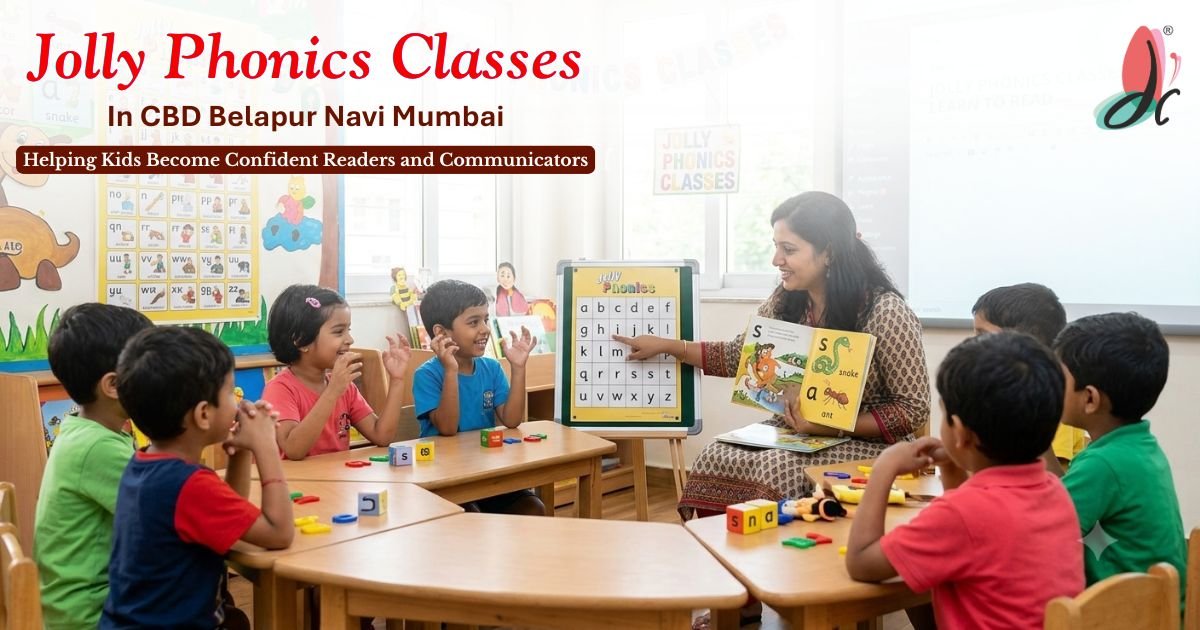
Whether you’re hunting for Jolly Phonics classes in CBD Belapur, Navi Mumbai, or leaning toward something online for the flexibility — either way works, honestly. Today’s programs are built to fit whatever setup suits your family. Engaging in-person sessions if you want the classroom energy, interactive virtual lessons if home works better. Either path, kids end up building the same strong reading and language foundation.
What is Phonics?
Most people figure reading’s one of those things — either a kid just gets it naturally, or they struggle with it forever. Not really true, though.
Reading’s a skill. Like most skills, there’s an actual system underneath it, something that can be taught rather than just picked up through exposure. Jolly Phonics is that system. It teaches kids how letters, and groups of letters, map to sounds. So instead of memorizing whole words one at a time, or guessing based on the first letter and whatever picture happens to be nearby, a kid can actually sound out something they’ve never come across before.
Here’s what that looks like in practice, though. A kid with solid Jolly phonics doesn’t need to have seen a word already to read it. They just look at it, work through the sounds piece by piece, and get there on their own.
That independence is what changes everything.
A structured programme typically teaches children to:
- Recognise individual letter sounds and how they behave in words
- Blend sounds together to build words from scratch
- Break words apart into their component sounds
- Develop spelling through understanding how words are constructed
- Build vocabulary and reading fluency progressively
It’s less about memorising words and more about understanding how language is assembled. Once children have that foundation, reading opens up.
Why Parents in Belapur Choose Jolly Phonics Classes
Belapur parents take early education seriously — and when it comes to reading, more of them are realising that waiting for school to sort it out isn’t always enough.
Strong literacy in the early years changes a child’s entire school experience. Here’s what consistently drives parents toward structured Jolly phonics classes:
Reading that actually sticks — Children learn to identify sounds quickly and accurately, which means they can read words they haven’t memorised. That’s a fundamentally more reliable skill than visual word recognition alone.
Pronunciation that develops naturally — When children understand how sounds work in combination, correct pronunciation follows without drilling. They hear it in themselves.
Spelling that makes sense — Children who understand jolly phonics tend to be noticeably better spellers, because they understand how words are built rather than just how they look.
Communication that grows — Better reading leads to stronger vocabulary, more confident speaking, and deeper language comprehension. These compound over time.
Confidence that’s hard to miss — A child who reads independently carries themselves differently in the classroom. That confidence doesn’t stay in the reading lesson. It spreads.
Benefits of Jolly Phonics Beyond Reading
Here’s what catches most parents off guard: jolly phonics does considerably more than teach children to read.
The skills that develop through a proper programme tend to show up across the school day. Better listening — the kind that comes from training children to hear individual sounds carefully. Stronger concentration, because jolly phonics activities require genuine attention to detail. Clearer speech, improved writing, higher participation in class discussions.
What tends to develop alongside the reading ability:
- Sharper listening skills and more careful observation
- Stronger vocabulary that builds naturally with each new word decoded
- Improved concentration and focus
- Enhanced comprehension — understanding what’s read, not just the words themselves
- Clear, accurate speech
- Better writing ability and sentence construction
- Greater self-confidence in classroom settings
These aren’t extras. They’re built into how the learning works.jolly
Online Jolly Phonics Classes – Learning from the Comfort of Home
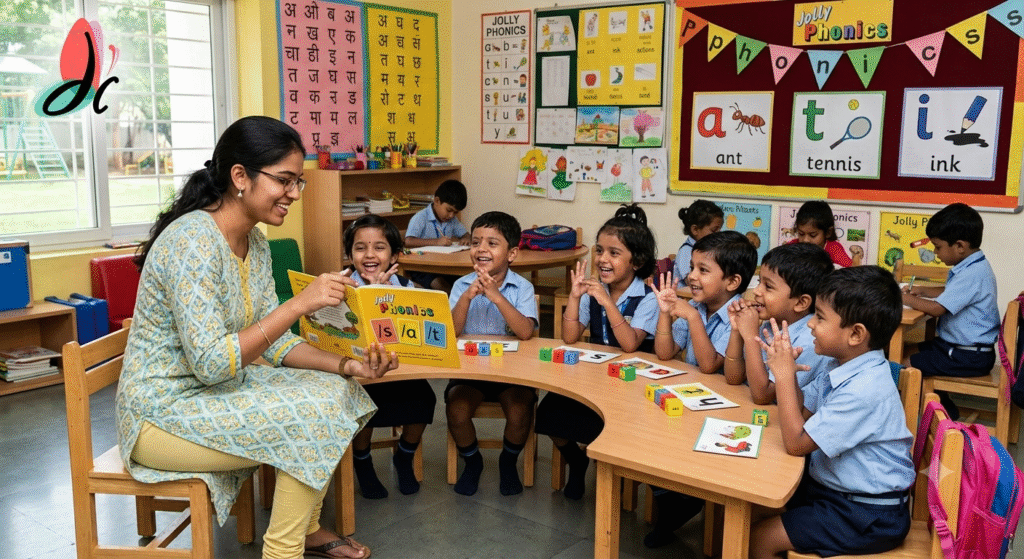
With digital learning becoming increasingly popular, online jolly phonics classes have emerged as an excellent option for parents seeking flexibility without compromising on quality. Interactive live sessions allow children to learn letter sounds, word blending, pronunciation, and reading techniques through engaging activities led by experienced educators.
Many parents now choose jolly phonics classes online because they provide:
- Live teacher-led sessions
- Interactive games and reading activities
- Digital worksheets and practice exercises
- Personalized attention in small batches
- Flexible class schedules
- Regular parent feedback
Whether your child is just beginning to read or needs additional support, online learning offers the same structured approach as classroom instruction while allowing them to learn comfortably from home.
Who Should Join Jolly Phonics Classes?
The honest answer is: earlier than most parents think.
Jolly Phonics works best when it starts during the years when children’s language development is naturally at its most receptive. But it also helps older children who are already experiencing reading difficulties — it’s never too late to build the foundation properly.
The children who benefit most include:
- Preschool and nursery children just beginning to engage with letters
- Kindergarten students starting their reading journey formally
- Children beginning primary school who need a strong literacy base
- Students who struggle with reading, mix up letter sounds, or avoid reading aloud
- Young learners who need stronger English language skills across speaking and writing
Early support matters because reading difficulties that don’t get addressed tend to compound. A child who struggles in Year 1 doesn’t automatically catch up by Year 3 — they usually fall further behind. Jolly Phonics closes that gap before it opens.
What Children Learn in Jolly Phonics Classes
JA well-structured jolly phonics programme doesn’t rush. It introduces reading concepts step by step, each stage building on what came before, with activities that feel engaging rather than like work.
Over the course of a good programme, children move through:
- Alphabet sounds and letter recognition from the beginning
- Starting sounds, ending sounds, and the patterns between them
- Blending sounds together to form complete words
- Segmenting words back into individual sounds
- Sight words — the common ones that appear everywhere
- Rhyming, sentence reading, and full story reading
- Reading comprehension and spelling techniques
Each concept connects to the last. By the time children reach story reading, every skill they’ve built feeds into the experience. Reading starts feeling less like decoding and more like understanding.
Online Jolly Phonics Classes for Young Learners
A well-built online & offline jolly phonics classes does something rote learning never quite manages — it gets kids to actually understand how sounds and letters fit together, instead of just memorizing and hoping it sticks. Through interactive lessons and activities suited to their age, reading starts feeling less like a chore and more like something that actually makes sense.
An online phonics program for kids usually includes:
- Alphabet sound recognition
- Word blending techniques
- Reading fluency practice
- Vocabulary building
- Story reading
- Pronunciation improvement
- Spelling activities
- Reading comprehension exercises
With consistent practice, children become confident readers who enjoy exploring books independently.
Interactive Learning Makes Reading Fun
Children who are bored don’t retain things. That’s not a controversial statement — it’s just how young learners work.
Good jolly phonics teaching in CBD Belapur knows this. The methods used in quality classes are deliberately engaging, because the moment reading feels like a chore, resistance builds. What that looks like in practice:
- Storytelling and picture reading that give words context
- Flashcards and word games that build recognition through repetition without feeling repetitive
- Action songs that link sounds to movement — particularly effective for younger children
- Group discussions and reading activities
- Creative exercises, worksheets that feel like play, educational puzzles
When children are genuinely engaged, the learning consolidates faster. And they actually want to come back next week.
Ideal Age to Start Jolly Phonics
Experts recommend introducing Jolly phonics between 3 and 7 years of age — and that window exists for a good reason.
These are the years when children’s brains are most primed for language acquisition. Sound patterns, letter recognition, reading fluency — all of it comes more naturally during this developmental window than it does later. Starting early doesn’t mean pushing a child. It means meeting them at the moment when their brain is most ready.
That said, older children experiencing reading challenges absolutely benefit from structured jolly phonics instruction. The approach adapts to the learner’s level. It’s never too late to build the foundation properly — it’s just easier the earlier you start.
How Jolly Phonics Supports School Learning
Stop and think about what a school day actually looks like for a child who struggles to read.
Every subject requires it. Science textbooks. History worksheets. Maths word problems. Instructions written on the board. Even the questions on an exam paper need to be read before they can be answered. A child who reads well moves through all of that smoothly. A child who doesn’t is fighting a battle in every single lesson, not just English.
Strong jolly phonics skills change that picture entirely. Children start reading their textbooks without needing someone to sit beside them and help. They follow written instructions the first time rather than waiting to copy a classmate. Spelling tests improve because they understand how words are built, not just how they look. Sentences in their writing become more complete, more confident. New vocabulary gets absorbed naturally just through the act of reading, without anyone having to teach it directly.
And the comprehension that develops — the ability to actually understand what’s being read, not just decode the words — shows up everywhere. In science. In social studies. In every subject that asks a child to read something and then think about it.
Reading isn’t an English skill. It’s the skill underneath all the other skills. Get that right early and everything else in school becomes measurably easier.
Choosing the Best Jolly Phonics Classes in Belapur Mumbai
While selecting a learning centre, parents should also consider whether the institute offers jolly phonics online classes. A quality program should provide both classroom and online learning options, ensuring children can continue their reading journey without interruptions, even during busy schedules or travel.
Not all jolly phonics programmes are equal. Some are excellent. Some tick the right boxes on paper without delivering much in practice. Here’s what actually matters when you’re choosing:
Instructor quality — A good jolly phonics teacher makes reading engaging while adapting to each child’s pace. The ability to spot where a specific child is getting stuck — and adjust — is more valuable than any curriculum on its own.
Small batch sizes — Individual attention isn’t a luxury in jolly phonics instruction. It’s a requirement. Errors in sound recognition need to be caught and corrected early, which doesn’t happen in a large group where the teacher can’t hear each child individually.
Structured, age-appropriate curriculum — The programme should have clear progression. Parents should always know what level their child is at and what comes next.
Activity-based teaching — If the class relies primarily on worksheets and repetition, that’s a warning sign. Good jolly phonics teaching is interactive and varied enough to hold a young child’s attention genuinely.
Regular parent feedback — You should get actual updates on progress, not just reassurance that things are going well. The more specific the feedback, the better you can support learning at home.
How Parents Can Support Learning at Home
The classroom gets the ball rolling. Home is where the learning consolidates.
You don’t need to become a reading tutor. Fifteen to twenty minutes a day of simple activities makes a meaningful difference — far more than occasional longer sessions. What helps most:
- Reading together every day, even just for a short time
- Practising letter sounds casually, in conversation or during play
- Playing word games that feel fun rather than educational
- Encouraging storytelling — spoken or drawn, not just written
- Singing alphabet and jolly phonics songs that reinforce sounds
- Using picture books that connect words to images
- Celebrating small wins genuinely, because confidence matters as much as skill
The children who progress fastest are almost always the ones whose parents are engaged at home. Not intensely — just consistently.
Frequently Asked Questions
Is jolly phonics suitable for beginners? Yes — it’s specifically designed for children at the start of their reading journey. The earlier the better, but programmes adapt to wherever a child is starting from.
How long before you see improvement? Most children show noticeable progress within a few months of regular attendance and consistent practice at home. The timeline varies by child, but improvement tends to be visible fairly early.
Can phonics improve spelling? Absolutely. Understanding how sounds map to letters — and how words are constructed — naturally improves spelling accuracy in a way that memorising word lists never quite does.
Is home practice necessary? Yes. Daily reading and sound practice reinforces what’s learned in class and accelerates progress significantly. Even brief, consistent sessions make a real difference over time.
Final Thoughts
Classroom or online, honestly doesn’t matter which one you pick. Investing in your kid’s early literacy is one of the better calls you’ll make as a parent, full stop. A structured jolly phonics course — in a room or on a screen — builds confident readers, sharpens pronunciation, strengthens spelling, and shapes communication skills that stick around well past the reading stage.
Because reading was never just an academic skill to begin with.
It’s the skill that makes all the others more accessible. And building it properly, early, with the right instruction, is one of the most straightforward investments you can make in your child’s confidence and capability.
At Delighted Champs, our jolly phonics programme is designed to meet children where they are and move them forward — through structured learning, genuinely engaging activities, and the kind of individual attention that makes a real difference. Come and see what that looks like for your child.