The Rubik’s Cube is a fascinating puzzle that has captivated humans worldwide considering its invention in 1974. This apparently simple toy, with its colorful, twisting squares, gives a complicated mission that could stump even the most skilled problem solvers.
Solving a Rubik’s Cube entails information and the technological know-how and arithmetic at the back of its mechanisms. This blog will explore the standards and techniques for fixing this fascinating puzzle.
The Structure of the Rubik's Cube
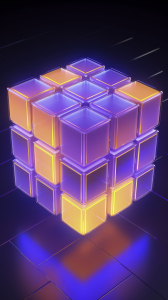
To understand how to solve a Rubik’s Cube, it’s critical to first recognize its structure. A widespread Rubik’s Cube is a 3x3x3 puzzle, such as 26 smaller cubes, additionally known as “cubies.” These cubies encompass:
Center Cubies: There are six center cubies, each located inside the middle of the dice’s faces. These are fixed and do not now pass. Each center cubie represents one coloration of the Rubik’s Cube.
Edge Cubes: There are 12 side cubes, each with colors. These cubes can move around the rims of the dice.
Corner Cubes: There are eight nook cubes, every with 3 hues. These cubies circulate across the corners of the dice.
The Basics of Cube Notation
Cube notation is a system used to describe the movements and rotations of the Rubik’s Cube. Each face of the cube is represented by a letter:
- F (Front)
- B (Back)
- U (Up)
- D (Down)
- L (Left)
- R (Right)
A letter alone means a 90-degree clockwise turn of the corresponding face. An apostrophe (‘) after the letter indicates a 90-degree counterclockwise turn. A number 2 after the letter means a 180-degree turn.
The Mathematics of the Rubik's Cube
The Rubik’s Cube is a permutation puzzle, that means that solving it includes arranging the cubies into a selected order. There are a stunning 43 quintillion viable configurations of the Rubik’s Cube, but simplest one solution.
The technological know-how at the back of fixing the Rubik’s Cube lies in organization concept, a branch of mathematics.
Group concept research the algebraic structures known as corporations, which encompass a hard and fast of elements and an operation that combines any two factors to shape a third detail.
In the context of the Rubik’s Cube, the elements are the numerous rotations and diversifications of the cubies, and the operation is the twisting of the dice’s faces.
Solving Techniques and Strategies
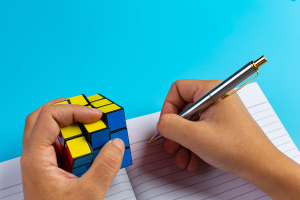
Solving a Rubik’s Cube calls for a sequence of algorithms, which might be sequences of moves that control the cubies into the favored position.
Here are a few not unusual techniques and strategies:
The Layer-by-way-of-Layer Method: This is the most famous method for beginners. It entails fixing the cube one layer at a time, beginning with the first layer (the white face), accompanied by means of the center layer, and in the end the ultimate layer (the yellow face).
First Layer: Solve the white pass, aligning the white aspect cubies with the corresponding middle cubies. Then, resolve the white corners, making sure the colors on the corners match the adjacent center cubes.
Second Layer: Solve the threshold cubes in the middle layer with the aid of the use of algorithms to surround them of their accurate positions without worrying about the already solved first layer.
Last Layer: Orient the yellow edges, then permute the yellow corners to complete the yellow face. Finally, use algorithms to put the final cubies successfully.
The CFOP Method: The CFOP (Cross, F2L, OLL, PLL) technique is a greater advanced approach utilized by speedcubers.
Cross: Solve the white pass on the primary layer.
F2L (First Two Layers): Solve the first layers simultaneously by way of pairing the threshold and nook cubies and inserting them into their accurate positions.
OLL (Orientation of the Last Layer): Orient the yellow cubies at the ultimate layer to make the entire face yellow.
PLL (Permutation of the Last Layer): Permute the yellow cubies to finish the cube.
The Roux Method: This approach specializes in fixing the dice in block as opposed to layers.
First Block: Solve a 1x2x3 block on one aspect of the dice.
Second Block: Solve a 2d 1x2x3 block on the alternative side of the cube.
CMLL (Corners of the Last Layer): Solve the corners of the final layer.
LSE (Last Six Edges): Solve the closing six edges to complete the dice.
Benefits of Solving a Rubik's Cube
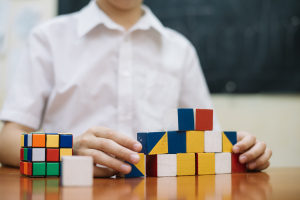
Solving a Rubik’s Cube offers several cognitive blessings. It complements trouble-solving abilities, improves reminiscence and attention, and encourages logical wondering. Additionally, it offers an experience of feat and boosts self assurance.
Problem-Solving Skills: The manner of solving a Rubik’s Cube requires breaking down a complicated problem into smaller, plausible steps. This technique can be implemented in various real-existence situations.
Memory and Concentration: Remembering algorithms and sequences of movements sharpens reminiscence and awareness. Regular practice can cause vast enhancements in these cognitive talents.
Logical Thinking: The Rubik’s Cube includes expertise patterns and predicting consequences based totally on precise actions. This complements logical questioning and analytical talents.
Patience and Persistence: Solving a Rubik’s Cube can be tough, especially for beginners. It teaches staying power and persistence, as it often takes a couple of tries to clear up the puzzle.
Conclusion
The Rubik’s Cube is more than just a toy; it’s a powerful tool for developing cognitive skills and fostering a problem-solving mindset. Understanding the science behind its mechanics, practicing various solving techniques, and applying mathematical principles can help anyone master this intriguing puzzle. Whether you’re a beginner or an advanced cuber, solving the Rubik’s Cube offers a rewarding experience that sharpens your mind and enhances your cognitive abilities.
So, grab a cube and start twisting your way to success!
Join us to give your child the head start they deserve.
For more information or to enroll, contact us at +91 7987764868 or email us at info@delightedchamps.com Start the journey towards academic excellence with Delighted Champs today!