


Picture your child mentally adding 47 + 68 in less time than it takes you to locate the calculator on your phone. It isn’t magic. It is the result of abacus practice that develops in children a whole-brain ability to envision and manipulate numbers.
At Delighted Champs, we teach the abacus to enable our young students to become confident and competent with numbers. It can be a dry subject so we find that the abacus really brings the subject to life for all ages; maths-hating children included!
This guide covers everything you need to know about the abacus, including a brief history, how our online tool works (with a worked example!), and how online abacus classes can boost your child’s maths ability.
Quick Overview
Topic | Details |
What it is | A frame with rods and beads used for calculation and training the mind in mental maths |
Our tool | Online abacus with 13 rods of different colours and a Clear / Reset button |
Bead layout | Each rod has 1 upper bead (worth 5) and 4 lower beads (worth 1 each) |
Best for | Children aged 4+, parents, teachers, schools and adult learners |
Skills built | Speed, accuracy, visualisation, concentration, listening skills, memory, confidence |
Live classes | 1-hour sessions, twice a week, at least 24 sessions per level |
Demo booking | +91 7987764868 |
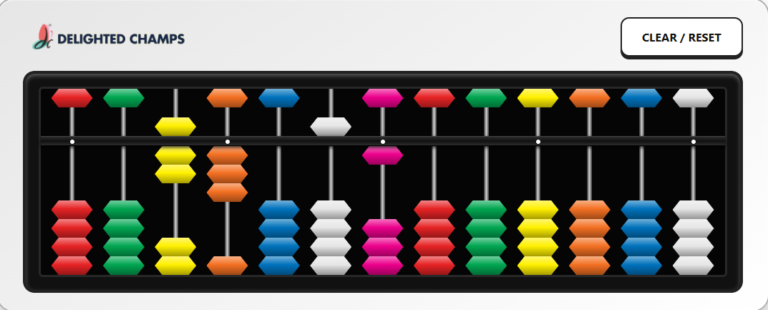
An abacus is a calculating tool. It has a frame with rods and beads that move along them. One of the very early ways of solving maths problems. Children may be taught the concepts of addition, subtraction, multiplication and division with an abacus. The beads placed on the rods represent numerically, ones, tens or hundreds. To do a calculation, you move the beads to the middle bar in a certain way.
The online version has 13 rods, each a different color, and a button to clear or reset it. The colours help younger children differentiate the place values and the Clear button lets them reset the abacus for a new sum.
To read the abacus, count the number of beads on each rod pushed towards the middle bar, ignoring the others. The abacus in the example above shows the number 73,051: 7 on the first rod (1 upper bead and 2 lower beads), 3, 0, 5 and 1.
Parts of an Abacus Explained: Understanding Its Structure and Functions
Part
What it is
Value or purpose
Frame
The outer border that holds all the other parts
Keeps the rods and beads secure
Rod
A vertical wire that runs along the length of the frame
Represents the place value of numbers (ones, tens, hundreds…)
Upper bead
The one bead above the reckoning bar on each rod
Worth 5
Lower beads
The four beads below the reckoning bar on each rod
Worth 1 each
Reckoning bar
The horizontal bar that runs across the middle of the frame
Beads are pushed towards this bar to calculate
Understanding Place Values on an Abacus: Ones, Tens, Hundreds, and Beyond
Reading from the right, each rod is worth ten times the value of the rod to its right.
Rod (from right)
Place value
If one lower bead is counted
If the upper bead is counted
1st
Ones
1
5
2nd
Tens
10
50
3rd
Hundreds
100
500
4th
Thousands
1,000
5,000
5th
Ten-thousands
10,000
50,000
A Brief History of the Abacus
Counting boards have been used for thousands of years. Merchants from the ancient world of Mesopotamia were the first to use counting devices. They used counting boards with lines and spaces where they placed stones that symbolized goods subject to taxation.
The word abacus is derived from the Greek word for a flat surface on which calculations are made, but even the ancient Greeks and Romans used counting tables although they weren’t the same tables as is designed for modern use. It was taken a stage further by the Chinese where it is called a suanpan. The Japanese improved the Chinese abacus and created the modern soroban, in which a single upper bead and four lower beads slide on a rod. Our online abacus tool uses this design.
Region | Name | What made it special |
Ancient Mesopotamia | Counting boards | Pebbles on marked surfaces for tracking tax and trade |
Greece and Rome | Counting tables and boards | Flat surfaces known as an abax for calculations |
China | Suanpan | Two upper beads and five lower beads per rod, popular with merchants |
Japan | Soroban | One upper bead and four lower beads per rod (modern design) |
Today | Online / virtual abacus | Same principle as before but on a digital medium for calculations |
Calculators and computers have been around for decades, but the abacus continues to be taught in schools across India, Japan, China and many other countries. It is a powerful tool to train the brain that produces the correct answer rather than telling a child what the answer is.
Why Use an Online Abacus Tool?
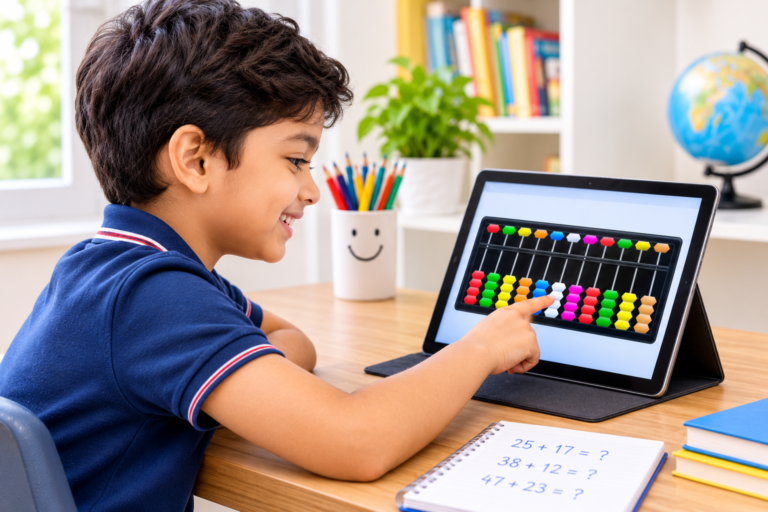
While a physical abacus is a wonderful tool for training the mind, the convenience of a virtual abacus fits more easily into a busy family schedule.
- There is no need to carry an abacus around and the online tool can be opened in your browser on your phone, tablet or computer.
- You can use the online abacus tool anywhere and at any time.
- It is easier for children to understand as the place values are colour-coded and the beads are moved around with simple clicks.
- Children can self-pace their practice. There are no pressures to keep up with the teacher, enabling children to complete sums as many times and at a speed as they like.
- It is designed to support live abacus classes. In an online class, the teacher can demonstrate the abacus on their own screen, and students can follow along at home, practising their own sums.
The tool is a screen-based abacus, but the ultimate goal is to encourage children to form a mental picture of the abacus, known as mental abacus.
Online Abacus vs Physical Abacus vs Calculator
Feature | Online abacus tool | Physical abacus | Calculator |
Needs to be carried | No, just open in your browser | Yes | Yes or a phone app |
Shows how numbers combine | Yes, each bead represents a value | Yes, each bead represents a value | No, only the answer |
Builds mental maths | Yes | Yes | No |
Reset in one tap | Yes | Beads must be moved manually | Yes |
Good for live online classes | Yes, easy to demonstrate | Harder to demonstrate online | Not useful for teaching |
Risk of being lost or damaged | None | Possible | Possible |
How to Add 23 + 14 Using an Abacus
The best way to understand the abacus is to use it. The illustration below shows the green rod as the tens and orange rod as the ones. The beads that are faded are the ones not being counted.
- Step 1: Set 23. Move 2 lower beads up on the tens rod. Then move 3 lower beads up on the ones rod.
- Step 2: Add 10. Move 1 lower bead up on the tens rod. The abacus now shows 33.
- Step 3: Add 4. The ones rod already has 3 lower beads moved up, and there is only 1 left. You cannot simply move 4 more lower beads as there are not enough. You’ll need to add a value of 5 using the upper bead and then subtract 1 (move it away from the centre bar). This adds 4 in one smooth movement, and the abacus now shows 37.
This works just like the “add 5 and take away 1” pattern taught in our classes. Children learn the patterns shown on the abacus and practice performing similar calculations until they can complete them without thinking. They then graduate to imagining the abacus to perform calculations in their head – a technique known as mental abacus.
Why Is the Upper Bead Important in an Abacus?
Each rod only has 4 lower beads – whenever a sum needs more than this, the upper bead (worth 5) is moved down to add a value of 5 to the number. Learning when and how to use the upper bead is the first big milestone in learning the abacus. It is the foundation of the “formulas of combination” taught in our Movers levels.
Here is a simple view of how the upper bead helps to add a value on a single rod, when a sum needs more than the lower beads can provide.
To add | Do this | Think of it as |
+1 | Move up the upper bead, take away 4 lower beads | +5 − 4 |
+2 | Move up the upper bead, take away 3 lower beads | +5 − 3 |
+3 | Move up the upper bead, take away 2 lower beads | +5 − 2 |
+4 | Move up the upper bead, take away 1 lower bead | +5 − 1 |
For subtracting, the same pairs apply but in the opposite direction. For example, -4 can be “remove the upper bead and add 1 lower bead” (−5 + 1). Larger combinations of tens and hundreds follow the same pattern.
Benefits of Abacus Learning for Children
Abacus is a whole brain tool and calculating is only one skill it helps develop. With regular practice, abacus builds these valuable skills in children…
Skill | How abacus builds it | Where it shows up |
Speed and accuracy | Repeated patterns make calculations faster and neater | Homework, tests, everyday shopping |
Visualisation | Learning to visualise the abacus builds imagination | Problem solving, mental calculation |
Concentration | Beads need to be moved precisely while calculating | Classroom focus, reading |
Listening skills | Many activities are performed by ear | Following instructions, note taking |
Memory | Recalling patterns supports working memory | Learning tables, remembering facts |
Confidence | Children see improvements in speed over time | Attitude towards maths and facing new challenges |
Many parents also notice an improvement in concentration that holds for reading and other pursuits. Learning the abacus can give youngsters the confidence to ‘play with’ numbers before maths anxiety takes hold.
Who Can Use an Online Abacus Tool?
Who | How they can use it |
Children (4+) | first, practice addition and subtraction, then move to multiplication and division |
Parents | Try a simple sum together, no abacus experience required |
Teachers and tutors | Demonstrate bead movements on screen during live sessions |
Schools and learning centres | Add an abacus activity to the maths programme, no equipment needed |
Adults | Develop mental maths and concentration – there is no age limit |
From Tool to Classroom: How Delighted Champs Makes Abacus Learning Fun and Effective for Children
A tool is a great start, but guided practice is the best way to develop abacus skills. Our live online abacus classes are led by expert teachers who make calculations fun and easy to understand. Here are some at-a-glance details about our classes.
Feature | Details |
Age | 4+ years |
Programme | 9-level certification, from Toddler to Grand |
Session length | 1 hour |
Frequency | 2 sessions per week |
Sessions per level | 24 or more |
Timings | Live tutoring 7 days a week, across time zones |
Languages | Multiple languages offered |
Extras | Writing exercises, tutorials, assessments and certification |
Access | Free courses for children from NGOs and underprivileged families |
FAQs
What age can my child start abacus?
Children can begin at age 4. The Toddler level is set up for those little learners.
Will my child be required to excel in mathematics initially?
No. We begin from the lowest.
How long does each level take?
Every level contains a minimum of 24 Sessions, twice a week, every one hour.
Can adults learn abacus?
Yes. Adults can also join and can take advantage too with mental maths and concentration.
Will my child always need the abacus?
No. It is mental abacus in which the child visualises the beads and does the calculation.
Can I access the online abacus on a phone?
Yes. You can access the online abacus on your phone browser.
Final Thoughts: Why Abacus Learning Is a Valuable Skill for Every Child
There’s no need for flashing yellow lights and a list of complicated equipment to build confidence in maths. It begins with a few beads, a curious child and time to practice.
Open the online abacus tool at Delighted Champs and play with 23 + 14. Ask your kid to move the beads and drop a line or give us a ring at +91 7987764868 to schedule a demo abacus class. We will then tell you which level should you start your child with.

