

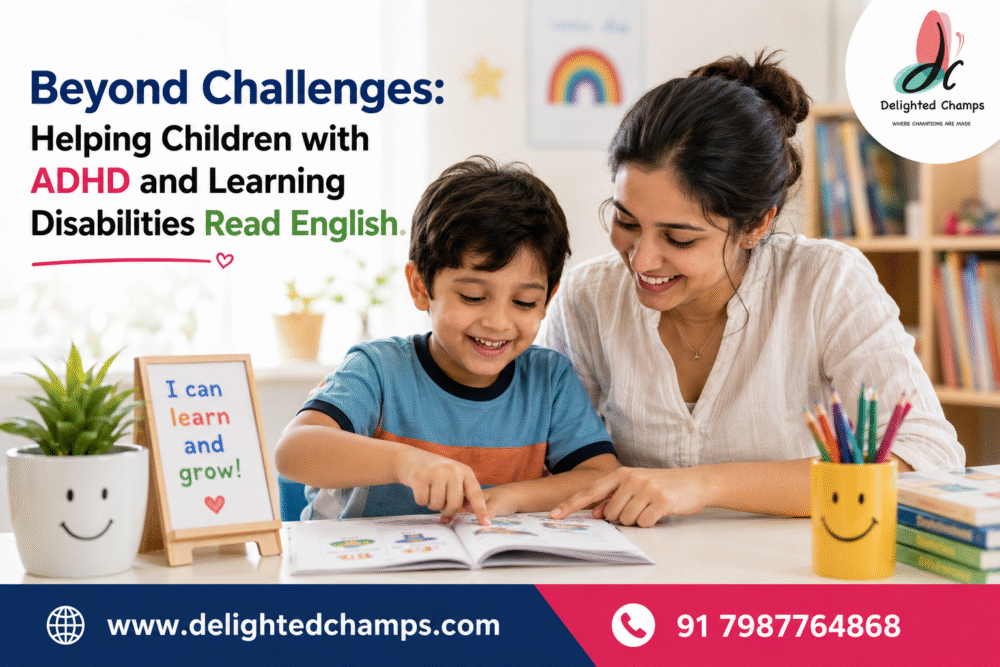
Does your child face reading difficulties?
Is he/she suffering from ADHD and learning disabilities?
Reading English opens doors to imagination, knowledge, and confidence. The journey of learning to read English is quite tough for children with ADHD or learning disabilities. It’s only the right support, patience, and proven methods that can help these children transform their academic and personal lives.
Delighted Champs believes that every child deserves the joy of reading. It offers a well-structured phonics program that helps young learners overcome their issues and hence helps in covering challenges as opportunities for their remarkable growth.
ADHD and learning disabilities affect the focus, working memory, and impulse control of children, further affecting attention during the reading sessions. Children with this issue struggle to connect words into meaningful ideas. The kids with this issue usually fail to decode sounds and blend them into words.
A child with ADHD may see letters clearly but hear the sounds jumbled, which further leads to a lot of frustration and avoidance of reading.
ADHD learning disability doesn’t mean that the kid is having low intelligence; in fact, a lot of people with ADHD are quite creative, energetic, and problem-solvers and have unique strengths. And that key is bridging the gap between their potential and traditional reading approaches.

The Power of Structured Phonics: A Game-Changer

Jolly Phonics Program is a teaching method and a systematic way for building reading foundations. It helps students in connecting sounds to letters. Structured phonics offers predictability and small, achievable wins for ADHD and learning disabilities and hence keeps their motivation high.
Jolly Phonics Program breaks reading into logical steps, making overwhelm work for working memory. For example, the simple sound is like /a/ in “cat.” Progress to blends, digraphs, and complex rules. This explicit sequential approach aligns perfectly with how brains learn best when attention or processing is variable.
The multisensory techniques in the learning process amplify this. These methods include seeing, hearing, touching, and even moving with learning. A child might trace letters in sand while saying the sound or can use blocks for building words. The same engages multiple brain pathways, hence making the information stick.
The learning sessions are kept short and engaging, further preventing fatigue. The involvement of breaks, gamification, and favorite topics makes the practice feel more like a play.
Real Progress in Action: Stories from Our Centers
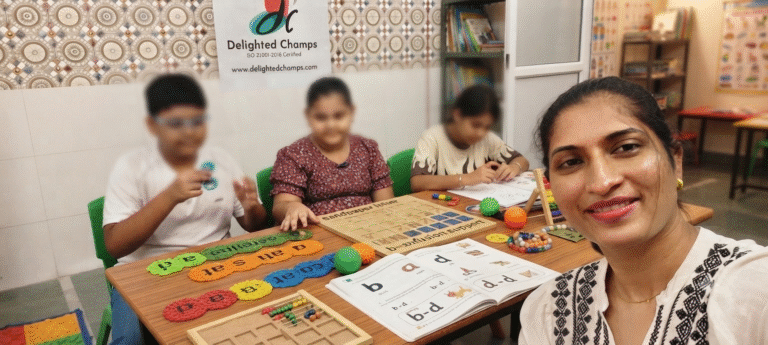
We witnessed this transformation firsthand in our own offline center. We had two students with special learning requirements. One of them is a 13-year-old boy with an intellectual disability, whereas the other one is 10 years old with ADHD. Both of them fail to connect sounds to letters at the very starting. Our Phonics Classes for ADHD children and our consistent guidance drove tremendous changes in them, and now both of them read English very confidently.
The 10-year-old student who once got distracted easily and was even reluctant to pick up a book now decodes simple sentences eagerly. His ADHD energy has not been channelled into active participation. The 13-year-old student faced broader cognitive challenges initially but now has gained independence and pride in sounding out words and opening up avenues for communication and self-expression.
These are not the only cases, but a lot of children today are gaining advantage with the the Jolly Phonics Program and are now decoding sentences with absolute fluency. The progress builds confidence and also reduces the anxiety of the student often related to reading sentences.
Strategies for Parents and Educators
Consistency and creativity serve as a great assistance for the children with ADHD and learning disabilities. The things you can follow during the learning process are
- Create a low-distraction reading zone
- Make the process multisensory and fun-filled
- Use technology very wisely
- Focus on the strengths and interests of the children
- Build executive function skills
- Collaborate with the professionals
The Broader Benefits: Beyond Reading
Mastering the reading of English helps students in academics. It improves vocabulary, critical thinking, understanding, and future opportunities. It helps the children in having better focus in other areas and also improves their confidence. Moreover, it also fosters independence and access to the world of information.
English proficiency today improves social connections, career paths, and cultural exploration.
Looking Ahead: Hope and Empowerment
Learning to read English in children with ADHD and learning disabilities empowers them and unlocks their potential. Every kid has a unique learning cap, and the right support helps them showcase their brilliance. Parents and educators can serve as the guides and make their journey easy in this journey.
If your child also faces reading challenges, don’t worry, as progress is possible. Well-structured and compassionate Jolly classes for ADHD make a lot of difference. We at Delighted Champs are committed to walking this path with families and helping students turn their challenges into a brighter future.
The world of reading is waiting for you. Just embrace these approaches and help children discover their voice, stories, and their place in the literate world.

