It is possible that the child is enrolled in a great school, is being taught by knowledgeable teachers, and completes all their homework, but the child cannot read.
It is a frequent issue parents have during the initial stages of their child’s learning. Parents might be wondering how their child is able to read the alphabet but is unable to comprehend simple words or reads slowly or spends an extended period of time to read on their own when they are able to comprehend the subject after being taught.
The Delighted Champs in CBD Belapur, Mumbai, we often hear from parents what they should do. If their child is already attending an excellent school, then why should we have separate classes for phonics? It’s not because schools aren’t doing their work. Schools have a myriad of objectives to meet, which include the standard curriculum, assessment math, writing in environmental studies, and classroom exercises, as well as other class tasks. Phonics demands a focused, consistent, individualized practice. The additional phonics help can provide children with the additional training and time they require for a better understanding of reading.
A Child Who Knew Letters but Read Slowly
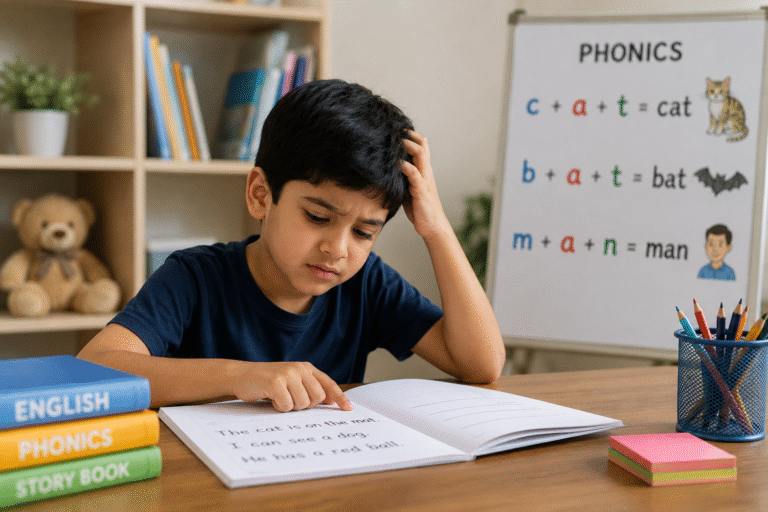
Take an example of one such situation that resembles those situations that parents usually give us. Here we will call the kid Aarav. Aarav had gone to a reputed school, and he was familiar with his ABCA. He knew many alphabets and words that belonged to him, and he could answer verbal questions from parents when a story was narrated to him. When his mother requested him to write a sentence on his own and independently, he began to change. He would frequently stop and pronounce some letters, think of others, and then take some time to read the three-liner. He would sometimes recognize the word after someone spoke the word out loud but was unable to identify the word until the word appeared printed on the paper.
The parents at first thought, “He is still young. The child will naturally improve.” But it is not uncommon for the issue to linger. It is not the case that reading becomes proficient simply because one grows older. Children require the proper base and ample chances to practice the connections between sound and letters. Children may be able to memorize the alphabet but may not understand how these letters function to form phrases. In this case, for instance, the combination of c and a + t = cat. The intention of phonics is not just to assist the child in remembering the words, but it assists them in understanding the relationship of the letters, words, and sounds for them to become more independent and self-assured in interpreting unknown words.
But Isn't My Child Already Learning Phonics at School?
Perhaps this is the most important question that parents should ask. Most schools do offer schooling in phonics, but then again it doesn’t mean mastery. Take, for example, the case wherein the teacher teaches the sounds of the alphabet to a class of children in one room. Although it is possible for a few of those children to grasp the concept easily, there will still be some who will need many repetitions before they can grasp it. There may be some who can recognize the sounds but are confused by other sounds and some who can make the sound but not blend them. There are some who will not be able to speak out, and there may also be some who will have the edge. The teacher should push ahead in spite of helping the whole group, and this is not a shortcoming of either the teacher or the school.
A specialized program for phonics could provide extra duration and repetition, as well as particular attention a child could need to improve their literacy skills. We at Delighted Champs, our approach is focused on areas in which every child requires extra help and helps build a strong base in the letter-sound blend, decoding, and improving their reading skills.
What Do Phonics Classes Add Beyond School?
1. One-to-One Attention and Correction
One of the most significant benefits of phonics training is that it is focused on personal attention. If a child is reading the wrong word, simply giving them the correct word will not be enough. It’s important to comprehend what caused the error. Are they combining two different sounds, skipping words and imagining the word based on an image, unable to combine sounds and reading every alphabet separately, and not combining the sound? When the root of the problem is uncovered, it may be dealt with through targeted instruction as well as guidance. This can be particularly beneficial when children read slow because repeated errors or reading mistakes will eventually become habitual when they’re not recognized and rectified in the early stages.
2. Small-Group Practice
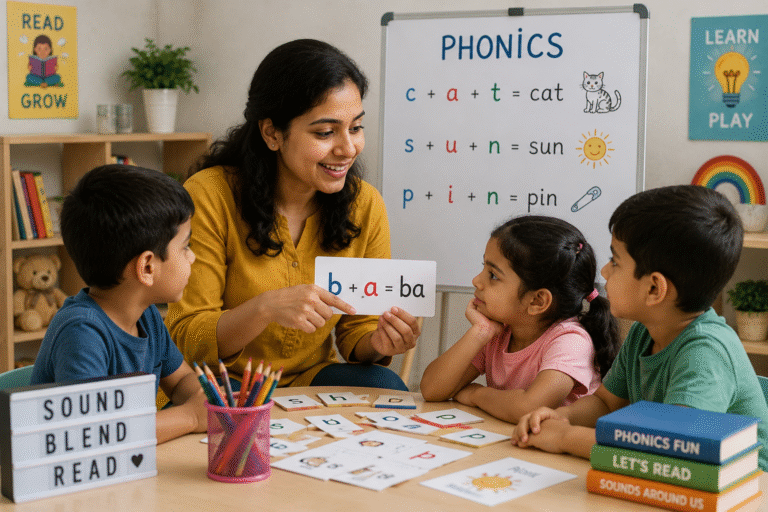
Children tend to learn faster in the context of being able to practice in a small number of students. With a less crowded learning space, kids have more opportunities to be involved, to listen to others who blend sounds, to learn on their own, to get corrections, to practice difficult patterns, and then to gradually get more comfortable with reading out loud. It is crucial to repeat the same pattern in the early stages of literacy, as a child may be able to comprehend a concept one time but require multiple opportunities to practice it until the ability develops into a habit. In Delighted Champs, our small-group practices in phonics are based on this concept, offering children regular opportunities to improve their literacy skills by the practice of guided repetition and guidance.
3. Personalized Assessments and Progress Tracking
Everyone isn’t at the exact same level; this is why our belief is that learning phonics shouldn’t be solely based on the age of a child or their school grades. One child who is in the first grade might have excellent recognition of letters but struggle to blend, and a different child might already mix simple words but require extra help with complex sounds. With a personalized assessment and progression tracking, we will be able to identify what level the child is at today and move them towards the next phase of their learning. Additionally, for parents, this gives them a glimpse of their child’s growth. Instead of hearing “My child is acquiring phonics,” parents are able to know what skills are growing and what the child is doing and what additional training could be necessary.
Learning Phonics Does Not Have to Feel Like More School
A different issue that parents face is the issue of resistance. After spending a lot of time in the classroom, kids aren’t keen on attending another class, which is reminiscent of another textbook class. The learning experiences are important. Here at Delighted Champs we employ the power of stories and games as well as interactive exercises in order to make phonics enjoyable and fun for kids. The child could practice the sounds by playing a game or identifying the sounds as they listen to an audiobook or learn to develop words instead of writing them out repeatedly. While the goal is still education, however, the process of learning is often fun and enjoyable. If children are engaged in something, they’re likely to do this activity over and over. Repetition is essential to creating strong reading skills.
Why Slow Reading Should Not Be Ignored
Many parents believe that slow reading is simply an individual characteristic. It is possible to think, “She’s very careful when reading.” “He is a slow reader,” the time to read, and “He will be faster in the future.” Although children are able to naturally have different reading speeds, but a steady slow rate of reading could be a sign that a child isn’t yet developing the ability to decode words automatically. Consider the way an experienced reader gazes at an unfamiliar word. They are not conscious of each letter individually; they can recognize the word quickly. The beginning reader, in contrast, will need to be able to comprehend each sound before mixing the sounds, which is normal for children in the beginning. The purpose of practicing phonics is helping children gradually transition from difficult decoding to better-informed and more fluent reading. The early identification of a challenge can offer parents and teachers an opportunity to provide an appropriate level of support and aid children to establish stronger foundations in reading.
A Good School and Additional Phonics Classes Can Work Together
The essential thing is to understand that choosing phonics classes additionally does not mean that parents consider the school that their kid studies in inadequate. Not quite. In fact, it could well be that parents are extremely pleased with the education that their child is receiving in school; still, they understand that they need some additional assistance. Consider other fields that involve less schooling. A child can attend math classes and receive extra math tasks in case the topic is difficult for him. In the same way, kids can learn how to play music at school and still take lessons since they enjoy it and want to improve their skills. In this way, school may teach a kid to read and write; however, phonics practice can offer additional assistance in certain aspects of reading. Both ways may be used together and complement each other.
What Makes Delighted Champs Different?
The Delighted Champs, CBD Belapur, Mumbai Our focus does not just revolve around completing another worksheet on phonics. Our focus is on the child’s specific needs, as well as their progress in their reading.
Additional phonics assistance we offer includes:
- Individual Correction—Recognizing and repairing specific reading or errors related to sound.
- Regular Practice—Giving regularly scheduled opportunities for practicing difficult patterns and sounds.
- Small-Group Learning: Giving each child more chances to be involved with others, play, and also to read aloud.
- Individualized Assessment: Understanding each child’s current reading levels.
- Progress Tracking—Observing progress in time, instead of just relying on one classroom exam.
- Interactive learning is the use of stories, games, and exercises to make phonics fun.
- Instilling confidence—Encourage youngsters to explore different words without hesitation instead of relying solely on their parents.
Our Goal
Our goal isn’t to rival your child’s current school. Our goal is to offer targeted practice and focus that a classroom is not always in a position to offer.
Online Phonic Classes for Children Who Need Flexible Learning
Families that are unable to frequently go to a local center for online classes for phonics can be a practical and flexible way to learn. The online learning option is particularly helpful for parents that want their children to get regular phonics instruction without having to add travel time onto their already packed school calendar. If you have the proper method of teaching and structure, kids can take part in story-telling, reading games, and individual corrections from home.
However, online phonics should not be allowed to become just screen time. Children should be allowed to have interaction through reading aloud, practicing the sounds, manipulating the words, and receiving feedback. Whether it is online instruction or in-person instruction using an active approach, this will ensure that children remain active and are able to learn their phonics skills.
How Do You Know if Your Child Needs Phonics Support?
The following signs can be checked out by parents:
- The slow reader reads extremely slowly for their age or stage of learning.
- Interrupts frequently: Pauses to read simple sentences.
- “Guiding” Words: Guesses the words rather than sounding out the words.
- Blending Difficulty: Understands each letter but is unable to mix sounds.
- Sound Confusion: Sometimes mixes together sounds that are similar.
- Refrains from Reading Aloud: Feels uneasy or uncomfortable reading to others.
- The person becomes frustrated while reading.
- Trouble Reading Independently: Reads the stories that someone reads to them but is unable to read on their own.
- requires substantial parental support for the simple task of reading.
A single sign is not a sign of the presence of a problem. But, if a few behaviors are seen frequently, a phonics or assessment of reading can assist parents to understand their children’s abilities and pinpoint the areas where further practice could help.
The Parent's Role Still Matters
The classes in phonics aren’t an attempt to replace parents. The parents are able to help reinforce their child’s development through easy and fun daily routines. Instead of making your child read an entire book each day, provide brief and fun reading times and look up pictures and words and play games of sound identification, and request your child to locate objects that start with a certain sound and then listen to bedtime stories with your child. The most important thing is to avoid turning each reading error into a correction time. Children need to be encouraged in addition to instruction, and a positive approach will help them be more willing to learn and experiment with new terms. The aim is to aid youngsters in gaining confidence and considering, “I can read this,” because that confidence plays a significant role in their path to becoming self-sufficient readers.
Looking for Phonic Classes Near Me?
If you’re searching for classes in phonics near me because your child is struggling to read, first, you should not be deciding on a school that is based solely on its location. Consider adequate help by asking.
- Does my child get individual care?
- What can you do to determine the current level of phonics in my child and reading proficiency?
- What are the best ways to spot and correct mistakes in reading?
- Are my child’s achievements being tracked frequently?
- How many repetitions and exercises can my child expect?
- Are they enjoyable and appropriate for younger learners?
This can assist parents in determining if the program is providing genuine assistance with phonics rather than replicating the learning process the child is already receiving in the classroom.
Looking for Phonic Classes in Belapur, Mumbai?
If you are a parent looking for phonics classes for their children in Belapur, Mumbai, Delighted Champs is a focused learning center for phonics for kids in the beginning phases of their reading development. Our program’s objective is to enable children to build stronger fundamental skills in reading through consistent practice, personalized teaching, small-group teaching, and interesting activities. We strongly believe that every child deserves time to learn at his or her own pace. The best schools provide an important base; however, often a child requires additional practice, repetition, more correction, and more attention from a teacher in order to transform that foundation into confidence. It is in this area that extra phonics help can make significant change.
Beyond Simple Memorization—Let Your Child Read With the Skills Required!
When your child is acquainted with the alphabet but reading slowly, it is not always necessary to say that they are behind or the schooling has done something wrong. On the contrary, what you need to think is whether your child needs more chances for reading. Undoubtedly, if your child suffers from special needs, then the answer would be yes. If they are given proper guidance, continuous practice, and support, then they would be able to recognize the sounds on their own after some time. This process of learning is well-coordinated at Delighted Champs.
If you’re parents living in or around CBD Belapur and are looking for phonics classes close to my home, looking into online classes for phonics, or specifically looking for the Belapur Mumbai phonics classes, contact Delighted Champs to understand how your child could benefit from additional assistance with their phonics. Sometimes, what makes one school different is not necessarily about a higher-quality school. Simply make sure your child is given more time to master the subject, work on it, and build confidence.